Anniversary

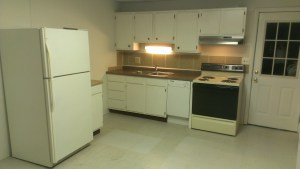
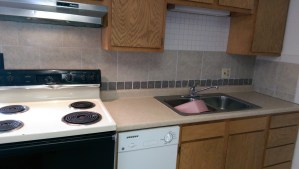
IOLL ghetto sink dont fitt’s been a year since my last post. I’ve been silent but I have not been idle — that too-small sink cutout from my last post got fixed by the plumber’s helper, who trimmed it easily with a grownup’s saw when he arrived to hook up the lines. Then I finished the cabinets with black paint, tiled the backsplash with 4 1/2 inch white squares, installed matching appliances and a new tenant moved in.  2013-08-23 13.38.05


The backsplashes add a lot, even though I use whatever tiles I find on the sale shelf at Lowes.


I’ve done two more kitchens since then, and have one more to go.

Here's one.  This place is already occupied.

Here’s one. This place is already occupied.

Here's another one, finished just last week.  Still needs caulk.

Here’s another one, finished just last week. Still needs caulk.

Disappointed trombones

A political commentator I enjoy calls it “shwang wang wang” — the three-note sound of let-down when something that presents itself as exciting, scary, formidable or otherwise a big deal turns out to be less so.

😦

It’s my circular saw.  I was afraid to make the first cut, and I know I still have to respect it because it can hurt me. OLL ghetto213 sink counter new uncut But after a couple of efficient cuts through various boards and then two laminate countertops, it took me three days to cut a hole for a sink in one of those countertops.  A plunge cut, then about three inches and a newly charged battery was dead.  I have a spare, which would go another 3-6 inches before it was dead.  Then about an hour of recharging before both batteries were ready to go another 6-9 inches.

Guess that laminate is a mighty foe for my 5 1/2 inch Ryobi.OLL ghetto sink hole

Then I cut the hole about a quarter inch too small somewhere along the perimeter, being overcautious not to cut it too large.  Once I had the counter glued in place and the tile backsplash in progress, it would have been awful to ruin it and have to start over.

So the sink isn’t fitting into the hole yet.  I have to cut it larger. The possibility remains I could screw up the whole thing and have to start over.

😦

I came, I sawed …

… I conquered my fear. What a great feeling.
I read the manual one more time and watched more YouTube videos of circular sawing and cutting down pre-fab countertops. I made a phone call when I needed help to attach the blade. I had bought a scrap length of countertop for practice, and after a couple of cuts on plain boards I measured off 2 inches on the underside of the dummy countertop and marked the line with a square. I drew a parallel line 1 inch from the first line and half-nailed a straight board along that line to use as a guide, being careful not to nail too deeply and pierce the surface of the material.
On the front side I ran a strip of masking tape along the saw line as I saw on YouTube.
I set the depth adjustment to 1 inch for the 3/4 inch countertop plus 1/4. I put on safety glasses. Then I made the cut.
Not perfect — I snagged up a bit on the thicker area — but it’s pretty good.
An unexpected hazard was the slippery sawdust on the shiny tile floor.
Then I cut off an 18-inch section from the practice countertop and covered the single cabinet that I had removed from the row to make room for a dishwasher. I’ll place that cabinet as a standalone next to the frig.OLL ghetto213 first countertop
Even having made that successful cut, I’m not fully confidant I can do my own countertops — I still haven’t tried to cut out a hole for the sink, still haven’t applied an end cap to the raw edge — but I’ve opened a huge log jam.
Difference in cost between doing my own countertop compared with ordering a pre-made and having it installed:
– I paid $80 for the first piece of countertop I plan to install, from a countertop manufacturer that went out of business near my home. They’re selling off inventory at $5-$10 per linear foot. A similar piece of unfinished countertop at Lowes is about $120 – $200, plus $20 delivery. I paid a kid about $10 to deliver it as part of an all-day delivery job that involved lots of items.
– A contractor would have charged at least $100, maybe more, to unhook the sink, make the cuts and install the counter.
– In either case I have to buy an end cap, about $19 at Lowes, which bring my countertop to $104 compared with at least $259 retail.
– By further comparison, the wonderful local lumber yard in my town would have built me a custom counter with end cap and cut the sink hole for $25- $27 per linear foot plus $5 delivery, or about $243, not including installation but that would have been pretty easy with the whole thing built. I plan to pay a plumber to reattach the sink in any case. I would have preferred to give the business to my lumber yard and I’d have no doubts about the quality and durability, but unfortunately I’m not in a position right now to support anyone but myself. That’s one of the many ways Walmart and Lowe’s continue to kill local businesses — customers are so concerned about their own survival they can’t consider the real cost of buying the cheapest thing.

I fear my saw

It’s true. I’ve had a brand new Ryobi cordless saw, nice and light with a 5 1/2 inch blade, since Christmas. I’ve read the manual five times in English and once in French. I have a number of things that need to be sawed. But I haven’t even attached a blade because I’m scared of the thing.
OLL circular saw
However, as I said, I have number of things that need to be sawed. I’ve reached a point in the student ghetto where I have to saw — kitchen countertops waiting to be installed, door frames needing to be built. I’ve been avoiding the circular saw by using the Rockwell oscillating multi tool with saw blade attachment, but the countertops and framing lumber require a bigger tool.
I’m letting my fear prevent me from completing my tasks. I stop for a coffee, run out to Lowe’s, have a little snack. But there are no alternate tasks remaining that I can do to avoid sawing.
Perhaps tonight’s the night.

I suck at caulk

Whoa, has it been over a month since my last post?

I haven’t been idle.  The students cleared out of the ghetto mid-May, and this is the first year in a long time, maybe ever, that all four of the apartments are vacant and unrented for the upcoming year.  Scary, because in my present situation the rent from those places is half my income.

That’s where I’ve been spending my time.

Meanwhile the stone house is doing fine, some turnover but new people coming in as the old ones move.  And they’re all great tenants with whom I am happy to share space.  Lost one of my two roomers at the brick house but a new guy is coming in tomorrow.  Again, great tenants and I’m not expecting any issues.

As I’ve said elsewhere, owning rental property used to be an investment.  I paid people to do the heavy work, got a little extra income and figured I sell the places eventually and put the money somewhere that padded my nest egg without wrecking my aging knees.

That was before my equity disappeared in the crash of 2007, my professional field — print journalism — tanked, and I apparently became too old to land the few jobs that survived.

There is no nest egg anymore.  I just thank god I was prudent with my investments and paid down principal whenever I had a chunk of cash.  Those who didn’t now find themselves owing more than their property is worth.  I’m not in that boat.  If I cashed out now I’d break even.

Breaking even sounds great if you’re 30 and ready to start over.  Not as great just a couple years from Social Security.  So I figure I have to hold on and hope the economy improves and real estate values rise faster than the pain my lower back.  Wake up, take two Aleve with a cup of coffee, go back to bed for 15 minutes until it kicks in.

What’s this have to do with caulk?  Guess I’ll have to rearrange this post when I return.  Work time now, though — the pills are working. 

You need help, girl

It’s good to have a helper, particularly a helper who’s working for free, has skills and arrives in a vehicle that can carry materials that won’t fit in my old Chrysler.

It does take an attitude adjustment to work with someone who’s more methodical than me and has to figure things out for himself rather than assuming I know what I’m talking about. Sometimes I know from experience; often in this new line of work I’m inexperienced but have done a fair amount of research; and yeah, sometimes I am clueless. But I’m not always clueless, and it takes an attitude adjustment on my part to accept help from someone who seems to assume I’m clueless in every case.

It didn’t take an attitude adjustment, however, to accept four days of free help when it was generously offered, because I just had a birthday and the assistance was a gift. I felt justified in accepting. In anticipation I made a list of five tasks I cannot not do alone. Two and a half of them got done, plus some landscaping tasks that weren’t on the list but were important with the rainy spring we’re having.

I’m grateful.

People more methodical than me must be more accustomed to delayed gratification than I am — for them it must be OK to put up with a longer period of getting ready to get a bunch of rewards all at once, at the end. Personally I prefer to enjoy the rewards of completed tasks more frequently. It keeps me motivated.

So when I had my helper we got ready to do a number of jobs — brainstormed, decided what we needed, went shopping for hours, spent a bunch of money and then delivered the stuff to the jobsite in the student-ghetto vacancy. All important. We never got around to completing any tasks, but the stuff is all there, ready to go, and plans are laid for how to proceed. If there are no snags in the execution it should be easy to wrap up a couple of things.

From my experience, however, no matter how much I plan and shop there is always something I didn’t plan for when the job is underway.
I’ll keep you posted about that.

Meanwhile, my delayed gratification cup was running over as my helper and I parted company at the stone house. I was itching for a job I could finish and look at.
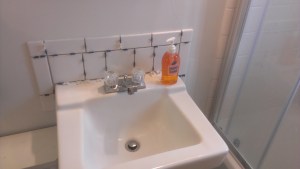
OLL stone house backsplash spacers.2I had purchased ceramic tile for a backsplash over the little sink in the second floor shared bathroom at the stone house and I was planning to move my tiling tools to the student ghetto job so I could tile the wall above the kitchen sink.

I’ve only done one prior tile job — also a backsplash — and it still seems like a major task even though it’s really pretty easy.

So before I left the stone house with the tools I wrapped up that little tiling job. The worst part was deciding how un-level I wanted to go — lined up with the sink, lined up with the medicine cabinet above, or actually level. Fairly important since it’s what you’re facing when you sit on the toilet so a problem would be seen daily. I split the difference between the sink and the cabinet and it looks OK. With just one row of tile and one row of bullnose it didn’t get terribly off level.

OLL stone house backsplash groutedI bought a premixed grout since I needed so little and it did shrink a bit so I’ll have to top it off next week. Still have to caulk up to the sink.

The best part was completing something that looks so substantial. I love tile. Learning how to install it is one of the most satisfying new skills I have acquired lately.

I get to look at it every time I use the bathroom.

Paint it black

Quick rundown with some of what I have accomplished and what I hope to accomplish in that vacant unit in the student ghetto.

I sometimes forget each of those places is a three-bedroom, two story house. Can be a lot of work when it’s totally trashed, as this one was.

Just to make it liveable, it needed five interior doors, three interior door frames and one exterior door frame, a new range, a new refrigerator, about a half dozen pieces of new wall paneling, four electric baseboard heaters, two dozen floor tiles, six window screens, at least a dozen ceiling panels. All of the above were destroyed by the wanton behavior by the last tenant, almost certainly fueled by alcohol.

Then, in addition to the replacement jobs, the place needs all of its filthy drop ceilings to be cleaned and painted, new paint in the bathroom, new carpet on the stairs, hallway and bedroom floors, a really good cleaning and polishing of the first floor vinyl floor and the big job, a major overhaul of the 1980s kitchen.
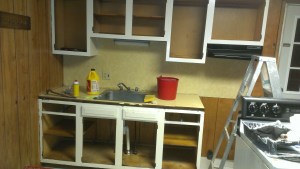
The old cabinets, doors removed

The old cabinets, doors removed

Just typing the list makes me edgy about writing rather than working, so I’m gonna close soon, but first a rundown of what I’m planning in the kitchen, keeping in mind that I have little money for the job.

In the last remodel a single 6-foot base counter was installed across the rear wall of the apartment with coordinating top cabinets and another 24-inch top cabinet and range hood to fill the space between the cabinets and the rear door with an apartment-sized range.
There’s never been an apartment-sized range there, always a second-hand, standard 30-inch range that sticks out six inches from the cabinet and hood above.

The refrigerator just sat randomly against the left wall.

The countertop is bright yellow laminate, nicely built and durable but like the cabinets that are solid wood but were never fine furniture, beat to hell from years of abuse and just butt ugly.

Also, the place needs a dishwasher. Few of today’s students are willing to live without one. The ones who do often just let the dishes pile up around the place until they graduate.

First I was gonna rip out and replace the cabinets. Too expensive and honestly, too big a job for my first cabinet project. Then I thought of replacing just the bottom unit with individual pieces to accommodate the dishwasher. Also expensive, also a huge challenge for my nascient skills, and the top cabinets would no longer line up with the base — the sink would be off-center under the shorter cabinet above it. And, it turned out, the unpainted cabinets in my price range were no better quality than the beat-up vintage ones set in place 30 years ago by contractors who obviously knew what they were doing.

The final plan, already underway at this writing — repaint the old cabinets, build a 24-inch space for the dishwasher where the range had been and put a new countertop over the whole run, increasing counter space by two feet. Tile the rear wall with whatever I can get for under $1 a square foot. Turned out the old base cabinet wasn’t standard height, so I’ll leave the 5/8 inch countertop in place and lay the new countertop on it. Even easier.

I’ll have to hire an electrician to move the 220 line against the left wall, where I’ll put a top cabinet with a range hood and a narrow base cabinet and top cabinet between the range and frig.OLL ghetto new cabinet
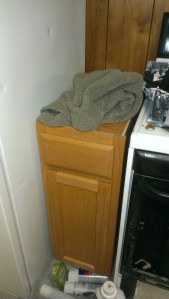
The local lumber yard was clearing out some old stock and I bought some decent oak cabinets for the range area — one 12-inch base, one 12-inch wall and one 30×18 wall for above the range, all three for under $100. Could have used a 15- or even 18-inch base cabinet in the available space, but they were’t selling any of those.

Haven’t committed yet to the Lowes countertop that I’d have to cut down myself, or the made-to-order one from the local lumber yard which would come with the sink hole cut and the end cap factory-installed. I’m leaning to the locals, it’s a great lumber yard that lets me run a tab and has a fabulous wood shop that does a lot of stuff for me, much of it free. The cost would be about $75 more but I do like to support the local business and I am scared of my circular saw.
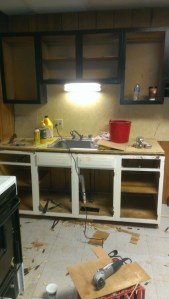
OLL ghetto cabinets top paint
For the range area, a sheet of laminate glued to the wall and a countertop made of two 12-inch black granite floor tiles with a porcelain-tile bullnose edge.

Decided to go with black paint on the old cabinets and leave the new oak ones alone. Try to coordinate everything with countertop and backsplash.

I’m not done talking but there’s no time for more. As I look at what I just said I’m less guilty about feeling exhausted. It’s a big job for one mildly arthritic person who has to learn how to do almost every task except painting before she attempts it.

Back to basics

It been a while since I posted so there’s much to tell.  But there’s also much to do so I’ll keep it brief.  Most of the work these last weeks has been on a single vacancy in the student ghetto.  The place was so totally trashed by the last tenants it was uninhabitable.  It’s been vacant for a year. 

That’s not unusual, as tenancy in that neighborhood follows the college calendar.  If a place isn’t rented by June or, at the latest, September, it’s unlikely to be occupied before the following June.

A 12-month vacancy hurts.  It’s 1/4 of the revenue that is 1/2 of my total income. That’s 12.5% of OLL’s current annual salary.

Anyway, the long vacancy was an opportunity for a needed facelift and, since I’m doing it myself, time to learn a few things that come easily to most handymen.  Things like hanging doors, as posted earlier.

I hope all the people who grew up helping their dad or someone else skilled in construction, mechanics, plumbing, wiring, etc., appreciate the free education they got.  These would mainly be guys.  I had none of that, although I do appreciate the traditionally female skills I acquired from my mom — sewing, cleaning, mending, cooking, heck, even ironing.  Guess some people don’t even learn that stuff now.

However, as an aside, I have observed that the people — women — who know how to sew, clean, cook, etc., get called on to do those tasks, while the ones who don’t end up with household help. Wonder if it’s the same with guys who can and can’t fix things.

Just curious. I need all those skills now, the girly ones I have and the macho ones I don’t.  The student ghetto duplexes, generically remodeled with sturdy, basic materials devoid of architectural distinction right before I purchased them in 1987, are perfect classrooms for me to learn all that stuff I need to know to be any good at the landlord biz.

I find as I dismantle the busted-up work of many handymen I’ve hired over the years that a lot of the work I paid for was real crap and some of it was good.  Probably paid about the same for both.

Digging for help

Hard to believe there isn’t tons of good advice on the web about painting drop ceilings.  I can’t be the only one stuck with them.

But I had to delve deeply into the internet to find a blog by a sweet Canadian woman who’s fixing up her townhouse on a tight budget.  She had a great tip — prop the tiles up slightly with a pair of long sticks — she used packages of furring strips — then paint the edges while they’re raised.  Then drop them down and use a roller to paint the centers of the tiles.

I don’t have any boxes of furring strips, but I will be buying narrow long lumber to repair door frames.  With something on the end to prevent puncturing the tiles — I’m thinking, tennis balls — it will sure save time if it works.

Thanks, Tanya, at http://dans-le-townhouse.blogspot.com/2012/04/basement-update-lazy-guide-to-painting.html

More on door

Hanging my first door, hearing it close with a successful click, was a major thrill. It couldn’t have been an easier door to hang, but it was still soo satisfying.

Cost: $21 at Lowes for a 24-inch hollow unfinished flat surface luan interior door. What I used to pay a contractor to hang a new door varied, but anywhere from $50 to $150, guesstimate.

For an expert the job would have been a no brainer because the old broken door was right there with the knobs in place. There was no trimming required, I had the three hinges and the door frame was fine with the striker plate in place. It was just a matter of exactly copying the hinge cutouts and the holes for the knobs.

Even so, I sweated it. And I didn’t have the perfect tool for the cutouts. I laid the old door on the new door and marked the location of the hinges, then traced the semicircular hinge on the door edge. I could see that the prior contractor used a tool that cut the exact shape and depth of the hinge in one fast move. I found out later the thing to use is a router with a hinge template, which I guess I should invest in since I have 32 interior doors among those four student ghetto units and some years more than half of them get smashed. The door frame often breaks along with the door, but that’s another chapter.

I did my hinge cutouts with my multi tool and a chisel — outlined the cut with the multi tool and then chiseled it out with small cuts until the hinge laid in there level with the surface.

I practiced four times on the old door before cutting into my pristine $21 door, which was actually pretty good looking. Really butchered the test door on the first try but each subsequent cut got closer to adequate as I learned to control the chisel.

Even so, each hinge cutout took 15-20 minutes and still looked choppy. It was hard to manage the depth of the cut. I worried that would make the door hang unevenly, but it worked.

The doorknob hole was easy — traced the old door, drilled a pilot hole and then one plunge with the right-sized hole saw from my lovely collection of new drill bits that goes with my lovely new cordless drill, a practical gift from a thoughtful friend.

I was grateful to get that drill and I’m grateful every time I drill a hole. Still, I wonder why some girls attract pretty, frivolous presents, serious bling, companions, and money, while I attract hardware. I’ve been a pretty good person; I wonder exactly which forks in the path of life sent me to this cold, solitary place.

Sometimes I wonder. Most of the time I’m just happy to have good tools.

When I got to the latch edge, again a router would have done it right. Used the 1-inch hole saw for whatever you call that part of the latch that comes out of the door knob and goes into the striker plate. With a router I could have made a shallow indentation around that hole for the plate that surrounds that thing whose name I don’t know.

As it was, I installed the edge plate on the surface as neatly as I could. It looked OK and worked fine. But I’m glad it’s not my bathroom door, where I’d see that imperfection several times a day.

OLL first door hinge closeupYou can see from the photo of the old door cutout that a router did the job perfectly and fast. I’m shopping for one. A little router you can carry around costs about $100. And a set of door templates costs about $10.

Probably should have stained the door before I hung it, but I was too anxious to see how it would hang. I drilled the nine holes for the hinge screws and hoisted it into the frame, using my toe and the handle of my hammer to level it while I turned the screws.

After the major satisfaction of hearing it close neatly without dragging anywhere on the frame, I gave it two coats of Minwax PolyShades American Chestnut colored stain/ polyurethane combo. There are so many different shades of stain on the woodwork in that place, but the chestnut looks OK.

It’s a light door, it’s a cheap door, but I gotta say, it looks as good as that kind of door can look. The job I did was just as good as anything done by the last professional contractor that worked in that place, and waay better than the crappy work done by the last couple of handymen I hired.